
Cali and the Cyclops
Every morning I walk my Jack Russell past the Faraglioni of Aci Trezza, rocks that Homer wrote about.
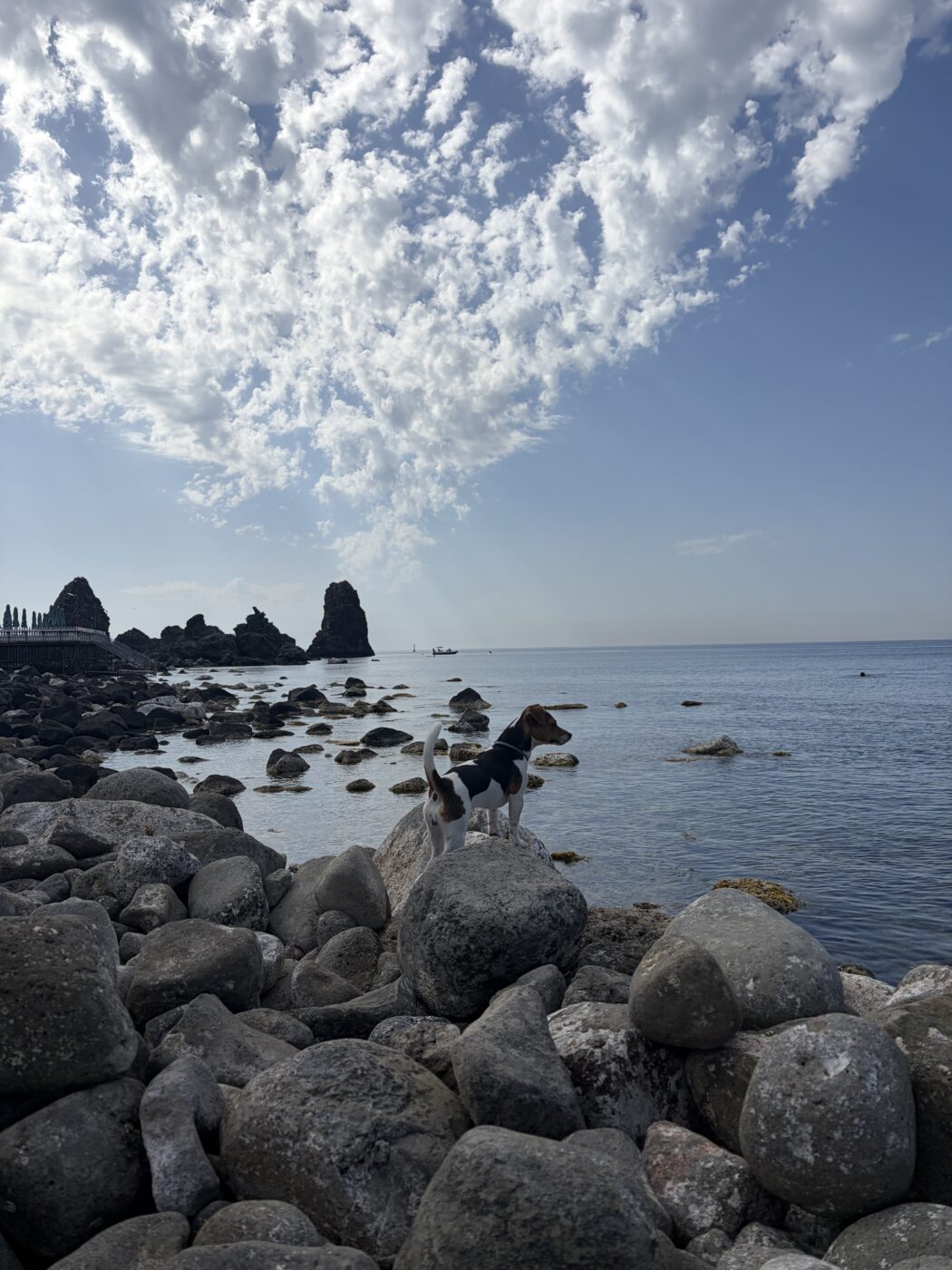
Waking up has never been my forte. I used to think the best start to the day was a large mug of coffee before the inevitable opening of my laptop. Now it’s walking Cali with a coffee still in hand, watching the sunrise over the Faraglioni. Have I become a morning person? Or is that the slow Sicilian effect?
I once read that we should get natural sunlight within the first hour of waking and keep away from our phones during that time too. I also read that we shouldn’t drink coffee for the first 60 to 90 minutes, something to do with cortisol. That one goes in one ear and out the other. But sunshine and no screens, those I can manage.
Cali is a Jack Russell with enormous energy, which means our morning walks are anything but a leisurely stroll. A sprint, a stop, a sniff, a long investigation of something invisible to me, then another sprint. The beach-goers haven’t arrived yet and the seafront is quiet. We walk along the Lungomare dei Ciclopi – the promenade of the Cyclops. The history here isn’t just in the rocks. It’s written in the street name.
And there, in the near distance, the Faraglioni catch the early light.
Three basalt rocks, rising straight out of the sea. There is something unusual about their placement, not out of place exactly, but odd. Dark, almost black, cracked into sharp angular formations by centuries of volcanic force and salt water. The largest is called Isola Lachea, a protected natural reserve with a marine biology research station and a museum with a collection of marine and land fauna, geology, mineralogy and archeology.
A friend who visited during her studies mentioned the island is home to a rare white spider. I can’t verify this, but I don’t doubt her. The whole area has been a protected natural reserve since 1998, managed by the University of Catania. You can take a boat tour around the stacks, but the island itself is off limits. One of the smaller stacks has a statue of the Madonna on it. Every year, the local fishermen go out to bring her flowers. The mythological and the sacred, hand in hand.
From the sea front they appear at different heights, but they aren’t intrusive or overpowering. They remind me of an old man sitting in silence, and that silence holds power. When he does speak, it carries weight.
There is a story about these rocks. And it starts with Odysseus and his crew, who were thrown off course after the fall of Troy and washed up on the island of the Cyclopes. Polyphemus, the one-eyed, enormous, son of Poseidon, trapped them in his cave and began eating them one by one. Odysseus got him drunk, waited until he fell asleep, then drove a stake into his eye. Polyphemus let out a roar that brought the other Cyclopes running.
Odysseus and his crew escaped by clinging to the underbellies of the Cyclops’s sheep, hidden in the wool as the animals emerged from the cave at sunrise. Polyphemus, raging and blind, passed his hand over the top of the sheep and felt nothing. But as their boat pulled away, Odysseus, stupidly, shouted back his real name. Now knowing his enemy, Polyphemus hurled two enormous rocks towards the voice, then prayed to his father to make Odysseus suffer. Poseidon listened and the journey home for Odysseus became a long torment.
Those rocks are the Faraglioni.
They are basalt, volcanic rock, the same material as Etna and the black-stone coastline of Aci Trezza. When you are out on a paddleboard, you can see Etna in the distance. This is true for most of east Sicily. She is always there. A reminder that this incredible and diverse landscape was made by fire. Etna is not just another thing to see; she is active, restless.
It’s a lot to contemplate on a morning walk, but it’s the perfect moment for it.
Johann Wolfgang von Goethe, the great German poet and writer, came through here in 1787. Visiting Catania, he examined mineral specimens collected from these very rocks, writing about his findings in his journals and referring to “the zeolites from the stacks which rise out of the sea off the coast near Jaci”. I imagine him crouched down with a scientist’s eye, trying to understand through geology what the myths had already explained. Reflecting on his time in Sicily, he wrote that it was here that the Odyssey became a living truth for him.
Standing on the Lungomare dei Ciclopi, I think I understand what he meant. The myths don’t feel like decoration, they feel like an explanation.
I stopped one morning to talk to one of the locals, Gianni, who is a master shipwright and who has the most beautiful brown husky. He was sitting just above his workshop on the seafront as he always does, sipping his pipping hot espresso. He has lived here since he was a child and naturally took over his father’s trade. I asked him what the Faraglioni meant to him. He looked out at the rocks and answered, “They have always been there, before me, before my father, my grandfather. They are part of the sea. I don’t think about the legend much, but I know of it.”
It’s crazy to think what I’m walking past each morning. The blinding rage of a giant. A hero’s miserable road home. It sounds bonkers, but in a weird way, it makes sense. At least in my mind.
Which brings us nicely to next week, where I’ll talk about the Aci towns and what’s behind the prefix. That story involves a Cyclops too. But this time, it’s a love affair.
Alla prossima,
Nadia