
A River by Any Other Name
The Aci towns all share a name, and it goes back to a shepherd, a sea nymph, and a very jealous Cyclops.
Last week I told you about the Faraglioni and the legend of the Cyclops in Aci Trezza. But there’s so much more to say.
Aci Trezza is a small fishing town about thirty minutes from Catania. In the winter you won’t see a soul, but come summer the Lungomare dei Ciclopi fills up with tourists and locals alike. If I’m honest, I prefer the winter months and the quiet. This is also the village Giovanni Verga wrote about in I Malavoglia, his 1881 novel about a family of fishermen and the hardship of their daily lives.
Reading it now, knowing the town, you can almost feel the same hardship still lingering in the air, the sea here has always given and taken in equal measure. That hasn’t really changed. In January of this year, Cyclone Harry tore through east Sicily, and Aci Trezza was one of the towns hit hardest. Overnight, the Lungomare was destroyed. Huge rocks blocking the road, buildings either flooded or reduced to rubble and the beach completely reshaped. Verga was writing about this same relationship between the town and the sea over a century ago and here it is again, playing out in real time.
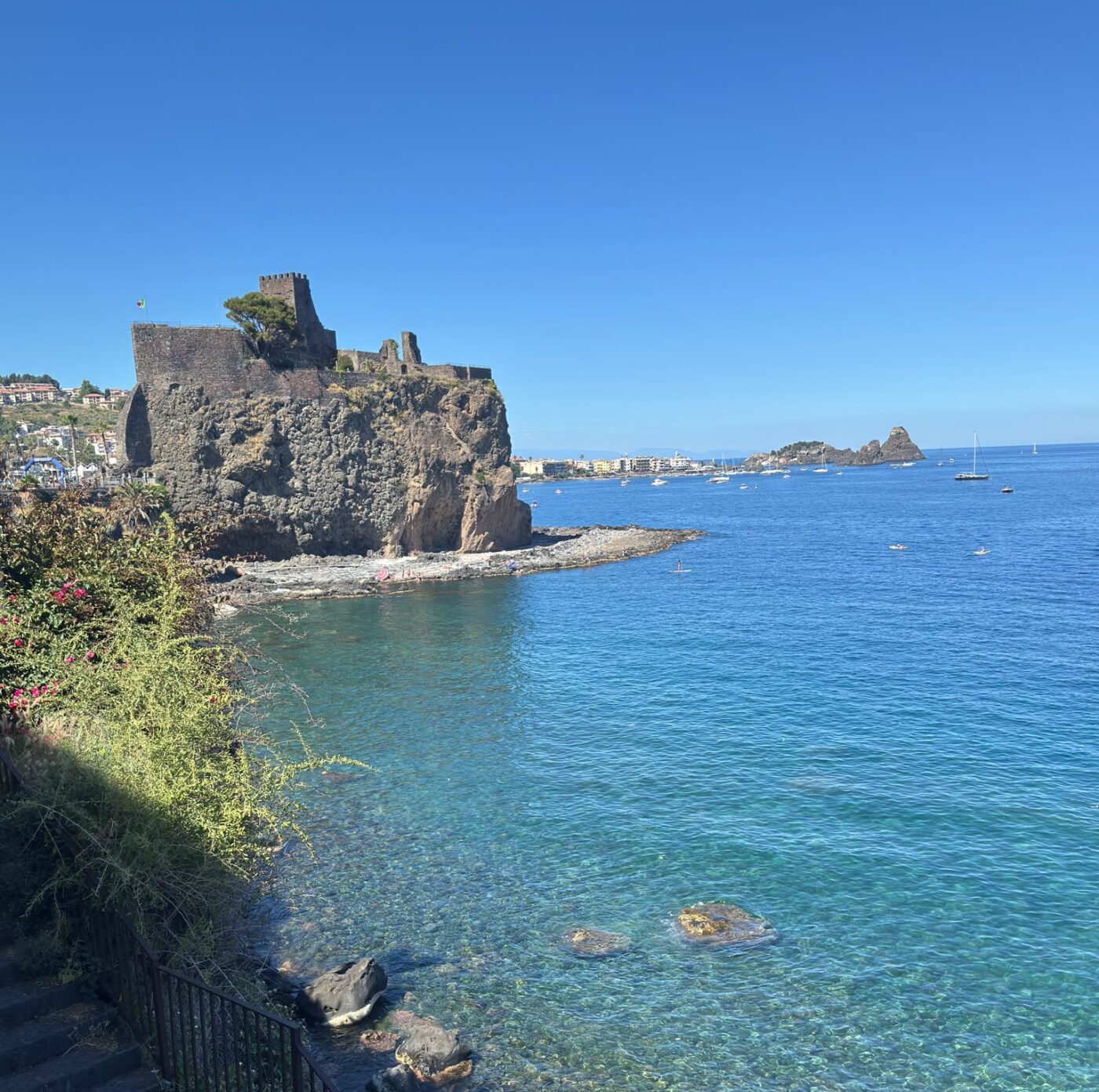
Aci Trezza is one of nine towns along the stretch of coast that share the Aci prefix. Next door, Aci Castello is known for its Norman castle perched on a black rock above the sea, whereas Aci Reale, the largest of the bunch, has incredible architecture with baroque churches and grand piazza. All of them sit on the lower slopes of Etna, all carrying the same name.
I’ll admit I was mispronouncing it for ages, until my partner finally corrected me. Turns out in Italian the “c” is actually a “ch”, not the soft “s” I’d been using. That got me curious about where the name actually came from, especially since I already knew Aci Trezza, Aci Castello, and Aci Reale.
He smiled, the way he does when he is about to tell me something about his homeland.
“It comes from the River Acis, named after a shepherd, the son of a river god”
“But where is the river now?”, I asked.
“Underground”.
He explained that this shepherd fell in love with a sea nymph named Galatea. But Polyphemus, the same cyclops mentioned in last week’s post, loved Galatea too. When he caught the two of them together, jealousy got the better of him, and he crushed Acis beneath a huge rock. Galatea, devastated by the loss of her love, turned his blood into a river. The River Acis.
The story comes from Ovid’s Metamorphoses, written around 8 AD, a Latin poem made up of stories about transformation, gods, mortals, love, jealousy and how things change into other things, people into trees, rivers, constellations, animals. At the heart of the tale of Acis and Galatea it isn’t really death, It’s Acis becoming the river, changing form rather than disappearing, which aligns with Ovid’s whole message. It’s a sad story, but there’s a kind of resolution in it too. Love, continuing in a different shape.
Not gonna lie, my first thought was Polyphemus, again. Rocks, again. This giant really couldn’t give it a rest. Hurling rocks the moment things didn’t go his way. But then I found myself thinking about Acis and Galatea, and how their story holds both beauty and sadness at once.
My partner told me all this while walking to Aci Castello, where he’d drop me off for my yoga class. I found a small studio here called Aria, and where they hold classes right beneath the Norman castle, overlooking the sea. If you’re ever in Catania and into yoga, I’d really recommend checking it out. When I arrived that day, there was a flock of chickens grazing on the grass behind us, just in front of the harbour. They looked completely out of place, but it made the whole scene kind of funny. I’ve heard of yoga with goats before, but yoga with chickens, that’s a new one for me.
I asked the yoga teacher, Giorgia, what made her choose this setting to practice. “I prefer to practice outside in the warmer months and the location sometimes changes, but always by the sea. Here, when you look up at the castle and out to the sea, you feel the history around you and can make the practice feel more grounded.”
I’ve practiced yoga since I was eighteen. It’s the only time my mind actually slows down, the only time I’m completely present. As the sun sets and the heat lifts, the sea goes still and the air falls quiet. It might sound odd, but it feels euphoric moving through the asanas, focusing on my breathing, taking in my surroundings, chickens included. It’s as if all the dots connect.
It’s a bit like learning something new, or picking up a language. Slowly, the connections start to form. My conversation with my partner struck a chord. It reminded me that just the week before, we’d practiced yoga somewhere else in Aci Castello, somewhere secluded, almost hidden. It is called the Galatea Mare, literally “sea nymph”. And the strange thing is, when I visited that spot , its beauty came with a sad serenity in the air. I imagine Galatea sitting on a rock waiting for Acis to return.
Sicily, it turns out, has more stories like this than I ever expected. Hidden underground, underwater, out of plain sight. Next week, I’ll tell you about a boy who became part fish and a relentless emperor obsessed with digging up Sicily’s secrets.
Alla prossima,
Nadia